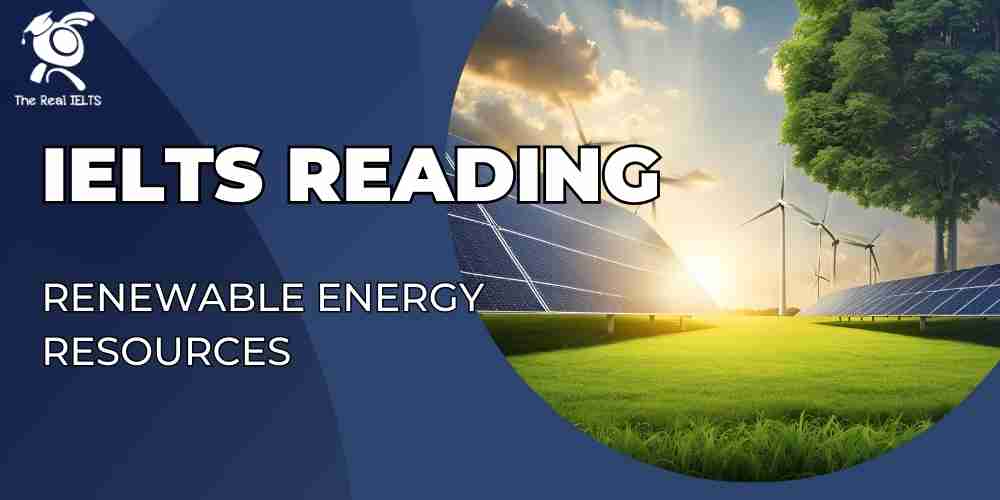
IELTS Reading 6: Renewable Energy Resources là chủ đề thuộc chuỗi bài luyện tập 11 dạng bài IELTS Reading và các bài tập luyện tập.
Học lại bài cũ: IELTS Reading 5: Rainforests and Biodiversity.
Renewable Energy Sources
Đọc kỹ bài passage bên dưới, sau đó trả lời các câu hỏi True / False / Not Given. Khi làm xong, nhấn “Check Answers” để xem đáp án, giải thích và điểm số của bạn.
Over the past two decades, renewable energy has moved from a niche experiment into a mainstream pillar of global electricity generation. Investment in solar, wind, and hydroelectric technologies has grown steadily, driven by falling equipment costs and rising public concern about climate change.
Solar power relies on photovoltaic (PV) cells that convert sunlight directly into electricity. The price of PV panels has fallen dramatically since 2010, making rooftop and utility-scale solar installations financially competitive with fossil fuel power plants in many regions. However, solar generation is intermittent, since output drops sharply at night and during cloudy weather.
Wind energy, harnessed through turbines placed on land or offshore, has become one of the fastest-growing sources of renewable electricity. Offshore wind farms can generate more consistent power than onshore installations because ocean winds tend to blow more steadily, but the infrastructure required to build and maintain turbines at sea is considerably more expensive to install.
Hydroelectric power, generated by channelling the force of flowing or falling water through turbines, remains the largest single source of renewable electricity worldwide. Unlike solar and wind, hydroelectric dams can store energy and release it on demand, which makes them valuable for balancing supply and demand across an electricity grid. Nevertheless, large dam projects can disrupt river ecosystems and displace local communities.
Despite the rapid expansion of renewable capacity, integrating these sources into existing grid infrastructure presents significant technical challenges. Because solar and wind output fluctuates, grid operators must invest in energy storage systems, such as large-scale batteries, and in more flexible transmission networks. Many governments continue to offer subsidies to accelerate this transition, although critics argue that funding should instead be directed toward developing more efficient storage technology.
Questions 1-7
Do the following statements agree with the information given in the Reading Passage? Choose TRUE, FALSE, or NOT GIVEN.
Mẹo nhận diện: Khi câu hỏi hỏi về một con số/số liệu cụ thể mà bài không hề đề cập, đáp án thường là Not Given, không phải False.
Mẹo nhận diện: Cẩn thận với các câu ghép hai thông tin có thật trong bài nhưng bài không so sánh trực tiếp — đây là bẫy phổ biến giữa False và Not Given.
Kết quả của bạn: / 7
Renewable Energy Sources — IELTS Cloze Test (C2 Level)
Renewable Energy Sources: Powering the Future
Over the past several decades, renewable energy has _____(1)_____ from a marginal curiosity into an indispensable component of the global energy mix. Solar photovoltaic technology, in particular, has undergone a remarkable cost _____(2)_____, falling from prohibitively expensive to broadly competitive with fossil fuels in under fifteen years. Wind power, too, has _____(3)_____ considerable pace, with offshore installations increasingly favoured for their comparatively _____(4)_____ output.
Nevertheless, the transition to a renewable-dominated grid is far from _____(5)_____. Because sunlight and wind are inherently variable, grid operators must _____(6)_____ substantial investment in storage infrastructure in order to _____(7)_____ supply with demand. Large-scale batteries, though improving rapidly, remain _____(8)_____ expensive to deploy at the scale required. Hydroelectric power, by contrast, offers a degree of dispatchability that solar and wind installations still _____(9)_____, since reservoir water can be released precisely when needed.
Critics further contend that government subsidies, while instrumental in _____(10)_____ early adoption, may eventually need to be redirected toward research into next-generation storage solutions if renewables are to achieve full grid parity without ongoing financial support.
Từ vựng khó trong bài
Mẹo C2: Với cloze test trình độ cao, đáp án sai thường là từ gần nghĩa bề mặt (đều liên quan đến “thay đổi”) nhưng sai về hướng hoặc sắc thái (tích cực/tiêu cực).
Kết quả của bạn: / 10
Renewable Energy Sources — IELTS True / False Reading (C2 Level)
The Global Shift Toward Renewable Energy
Geothermal energy, extracted from heat stored beneath the Earth’s crust, offers one of the few renewable sources capable of supplying continuous baseload power, since subterranean temperatures remain largely unaffected by weather or time of day. Its deployment, however, has historically been confined to regions with accessible tectonic activity, such as Iceland and parts of East Africa, limiting its contribution to the global energy mix relative to solar and wind.
Biomass energy, derived from organic matter including agricultural residues and dedicated energy crops, presents a more contentious case. Proponents argue that, when sourced sustainably, biomass can be considered carbon-neutral, since the carbon dioxide released during combustion is offset by the carbon absorbed during the growth of the source material. Critics counter that large-scale biomass cultivation can compete with food production for arable land and, in some cases, accelerate deforestation rather than mitigate it.
Meanwhile, the economics of energy storage have shifted markedly over the past decade. Lithium-ion battery costs have declined by more than eighty per cent since 2013, a trend that has rendered hybrid solar-plus-storage projects increasingly viable without government subsidy in several markets. This has, in turn, accelerated a broader move toward decentralised grids, in which local microgrids generate and store power independently rather than relying exclusively on centralised transmission networks.
Policy frameworks nonetheless continue to shape adoption rates disproportionately. Countries that have implemented feed-in tariffs or carbon pricing mechanisms have generally seen faster renewable uptake than those relying solely on market forces, suggesting that regulatory intervention remains indispensable, at least in the medium term, for accelerating the transition away from fossil fuels.
Từ vựng khó trong bài
Mẹo nhận diện: Khi câu hỏi diễn giải lại nguyên nhân-kết quả đúng như bài gốc (dù đổi từ vựng), đó thường là True.
Mẹo nhận diện: Cảnh giác với các từ tuyệt đối như “equal”, “all regions” — đây thường là dấu hiệu của câu False khi bài gốc mô tả sự giới hạn/không đồng đều.
Mẹo nhận diện: Từ “all experts agree” là bẫy kinh điển khi bài gốc trình bày hai luồng quan điểm trái chiều (proponents vs. critics).
Mẹo nhận diện: Từ “always” biến một hiện tượng “có thể xảy ra trong một số trường hợp” (in some cases) thành một quy luật tuyệt đối — đây là kiểu bẫy phổ biến ở trình độ C2.
Mẹo nhận diện: Đảo ngược một điều kiện phủ định (“without subsidy”) thành khẳng định (“require subsidy”) là kỹ thuật gài bẫy thường gặp.
Mẹo nhận diện: Cẩn thận với câu hỏi đảo ngược kết luận của bài — đặc biệt khi bài dùng “remains indispensable” (vẫn cần thiết) mà câu hỏi lại nói “no longer necessary” (không còn cần thiết).
Kết quả của bạn: / 10
Tidal & Wave Energy — IELTS Summary Completion (C2 Level)
Tidal and Wave Energy: The Next Frontier
Although solar and wind installations dominate public discourse on renewable energy, marine sources — namely tidal and wave power — remain comparatively underexploited despite their considerable theoretical potential. Tidal energy harnesses the gravitational pull of the moon and sun on ocean water, a process that produces predictable, cyclical patterns unlike the more erratic behaviour of wind. This predictability constitutes one of tidal power’s principal advantages, since grid operators can forecast output with far greater precision than is possible for solar or wind generation.
Wave energy, by contrast, captures the kinetic energy of surface waves through devices such as oscillating water columns and point absorbers. Unlike tidal power, wave energy is available almost continuously along many coastlines, yet the technology has been slower to mature commercially. Engineers attribute this lag primarily to the harsh marine environment, in which prototype devices are frequently damaged by corrosion, storms, and biofouling — the accumulation of marine organisms on submerged surfaces.
Both technologies also face a shared obstacle: the prohibitive cost of underwater cabling required to transmit electricity from offshore installations to onshore substations. Industry analysts estimate that cabling and installation can account for up to forty per cent of total project expenditure, a proportion considerably higher than for comparable onshore renewable projects.
Despite these challenges, several governments have begun offering targeted grants to accelerate research into marine energy, recognising that a diversified renewable portfolio — one that includes tidal and wave power alongside solar and wind — would reduce overall dependence on weather-sensitive sources and improve the resilience of national grids.
Từ vựng khó trong bài
Marine energy sources, such as tidal and wave power, remain relatively (1) compared with solar and wind, despite their considerable potential. Tidal power is generated by the (2) pull of the moon and sun, producing (3), cyclical patterns, which allows grid operators to plan output more accurately than with wind or solar. Wave energy, generated through devices like (4) and point absorbers, is available almost (5) along many coastlines. However, its commercial development has been slowed mainly because prototype devices suffer damage from corrosion, storms, and (6) in the harsh marine environment. Both tidal and wave technologies share a major obstacle: the high cost of underwater (7) needed to carry electricity to shore. According to industry analysts, this can represent as much as (8) per cent of a project’s total cost. Even so, some governments now offer (9) to support marine energy research, since a more (10) renewable portfolio could make national grids less dependent on weather and more resilient.
(1) underexploited — Đoạn 1: “marine sources… remain comparatively underexploited despite their considerable theoretical potential.”
(2) gravitational — Đoạn 1: “Tidal energy harnesses the gravitational pull of the moon and sun.”
(3) predictable — Đoạn 1: “a process that produces predictable, cyclical patterns.”
(4) oscillating water columns — Đoạn 2: “devices such as oscillating water columns and point absorbers.”
(5) continuously — Đoạn 2: “wave energy is available almost continuously along many coastlines.”
(6) biofouling — Đoạn 2: “damaged by corrosion, storms, and biofouling.”
(7) cabling — Đoạn 3: “the prohibitive cost of underwater cabling required to transmit electricity.”
(8) forty — Đoạn 3: “can account for up to forty per cent of total project expenditure.”
(9) targeted grants — Đoạn 4: “several governments have begun offering targeted grants to accelerate research.”
(10) diversified — Đoạn 4: “a diversified renewable portfolio… would reduce overall dependence on weather-sensitive sources.”
Mẹo nhận diện dạng Summary Completion: (a) Luôn xác định TỪ LOẠI cần điền trước (danh từ/tính từ/động từ) dựa vào ngữ pháp câu tóm tắt — điều này loại bỏ ngay nhiều phương án sai. (b) Từ đúng luôn xuất hiện NGUYÊN VĂN trong bài đọc (đúng chính tả), không được chia động từ hay đổi dạng số ít/số nhiều. (c) Đọc kỹ giới hạn số từ (ví dụ “KHÔNG QUÁ BA TỪ”) vì các cụm như “oscillating water columns” hoặc “targeted grants” cần điền nguyên cụm chứ không phải một từ đơn lẻ. (d) Dùng từ khóa xung quanh chỗ trống (ví dụ con số, danh từ riêng) để định vị chính xác câu tương ứng trong bài đọc trước khi chọn từ.
Kết quả của bạn: / 10
Green Hydrogen — IELTS Short-Answer Questions (C2 Level)
Green Hydrogen: A Missing Piece in the Renewable Puzzle
Hydrogen has long been discussed as a versatile energy carrier, capable of storing and transporting energy across sectors that are notoriously difficult to electrify directly, such as heavy industry, aviation, and long-haul shipping. What distinguishes “green” hydrogen from its more common counterparts is the method of production: green hydrogen is generated through electrolysis, a process that splits water into hydrogen and oxygen using electricity drawn exclusively from renewable sources such as solar or wind. By contrast, so-called “grey” hydrogen, which currently accounts for the vast majority of global hydrogen supply, is produced from natural gas through a process called steam methane reforming, releasing significant quantities of carbon dioxide in the process.
The principal obstacle to scaling green hydrogen production is cost. Electrolysers, the devices used to split water molecules, remain expensive to manufacture, and the process itself demands substantial amounts of electricity, meaning that green hydrogen is currently several times more costly to produce than grey hydrogen. Nevertheless, industry analysts project that electrolyser costs could fall by roughly sixty per cent by 2030 as manufacturing scales up and technology matures, potentially narrowing the price gap considerably.
Beyond cost, infrastructure presents a further challenge. Hydrogen molecules are notoriously prone to leakage and require specialised, often costly, pipelines and storage vessels distinct from those used for natural gas. Some governments have responded by proposing “hydrogen hubs” — geographically clustered facilities that combine production, storage, and end-use industries in close proximity, thereby minimising the distance hydrogen must travel and reducing both transport costs and leakage risk.
Despite these hurdles, several national energy strategies now identify green hydrogen as indispensable for decarbonising sectors where direct electrification remains impractical, suggesting that its role, though currently modest, is likely to expand substantially over the coming decade.
Từ vựng khó trong bài
Giải thích: Đoạn 1: “sectors that are notoriously difficult to electrify directly, such as heavy industry, aviation, and long-haul shipping.” Câu hỏi chỉ cần liệt kê hai lĩnh vực còn lại ngoài heavy industry.
Mẹo nhận diện: Với short-answer, hãy tìm danh sách liệt kê (thường có dấu phẩy hoặc “such as”) trong bài — đáp án thường nằm nguyên trong danh sách đó.
Giải thích: Đoạn 1: “green hydrogen is generated through electrolysis, a process that splits water into hydrogen and oxygen.”
Giải thích: Đoạn 1: “a process that splits water into hydrogen and oxygen.”
Giải thích: Đoạn 1: “so-called ‘grey’ hydrogen, which currently accounts for the vast majority of global hydrogen supply, is produced from natural gas.”
Giải thích: Đoạn 1: “produced from natural gas through a process called steam methane reforming.”
Giải thích: Đoạn 2 mở đầu trực tiếp: “The principal obstacle to scaling green hydrogen production is cost.”
Mẹo nhận diện: Với câu hỏi “What is the main/principal obstacle/challenge…”, hãy tìm câu chủ đề (topic sentence) ở đầu đoạn — đáp án C2 thường nằm ngay trong câu mở đoạn.
Giải thích: Đoạn 2: “Electrolysers, the devices used to split water molecules, remain expensive to manufacture.”
Giải thích: Đoạn 2: “industry analysts project that electrolyser costs could fall by roughly sixty per cent by 2030.”
Giải thích: Đoạn 3: “Hydrogen molecules are notoriously prone to leakage and require specialised… pipelines and storage vessels.”
Giải thích: Đoạn 3: “Some governments have responded by proposing ‘hydrogen hubs’ — geographically clustered facilities that combine production, storage, and end-use industries in close proximity.”
Mẹo nhận diện: Các thuật ngữ đặt trong dấu ngoặc kép trong bài đọc thường chính là đáp án cho câu hỏi định nghĩa/thuật ngữ.
Kết quả của bạn: / 10
Solar Panel Recycling — IELTS Reading Comprehension (C2 Level)
The Hidden Challenge of Solar Panel Waste
As the first generation of large-scale photovoltaic installations approaches the end of its operational lifespan, typically estimated at twenty-five to thirty years, the renewable energy sector confronts an unglamorous but increasingly pressing question: what becomes of the panels themselves once they are decommissioned? Industry projections suggest that global solar panel waste could reach several tens of millions of tonnes by the early 2050s, a volume substantial enough to strain existing waste-management infrastructure if left unaddressed.
A standard photovoltaic panel is a composite of glass, aluminium framing, silicon cells, and small quantities of valuable metals such as silver and copper, alongside polymer layers that bind these components together. Glass alone typically constitutes around seventy per cent of a panel’s total weight, and while it can, in principle, be recovered and reused, the polymer encapsulation layer complicates separation, since dismantling the panel without damaging the glass often requires specialised thermal or chemical processes rather than simple mechanical disassembly.
Several jurisdictions have begun mandating structured recycling programmes. The European Union, for instance, classifies photovoltaic panels under its Waste Electrical and Electronic Equipment directive, obliging manufacturers to fund collection and recycling schemes. Elsewhere, regulatory frameworks remain considerably less developed, and a substantial proportion of decommissioned panels are simply landfilled, squandering recoverable materials and, in some cases, risking the leaching of trace metals into soil and groundwater.
Proponents of a circular economy approach argue that panel manufacturers should be encouraged, through financial incentives or regulatory mandates, to design products with disassembly in mind from the outset — an approach sometimes termed “design for recycling.” Advocates contend that such foresight could substantially lower the cost of eventual material recovery, potentially transforming what is currently viewed as an environmental liability into a secondary source of raw materials for future panel manufacturing.
Từ vựng khó trong bài
Mẹo nhận diện: Với câu hỏi về số liệu cụ thể, hãy quét (scan) bài đọc tìm con số chính xác thay vì suy luận — đáp án luôn nằm nguyên văn hoặc rất gần với con số trong bài.
Mẹo nhận diện: Distractor ở trình độ C2 thường lấy đúng danh từ có trong bài (glass, aluminium, silicon) nhưng gán sai nguyên nhân — cần đọc kỹ mối quan hệ nhân-quả, không chỉ nhận diện từ khóa.
Mẹo nhận diện: Với câu hỏi hỏi nghĩa của một thuật ngữ được định nghĩa ngay trong bài, đáp án gần như luôn là câu diễn giải lại (paraphrase) của định nghĩa đó — tìm đúng câu chứa thuật ngữ trong ngoặc kép.
Mẹo nhận diện: Với câu hỏi “main purpose/overall idea”, loại trừ các phương án chỉ đúng với MỘT đoạn (too narrow) hoặc đi ngược lại thái độ chung của tác giả (tone mismatch) trước khi chọn.
Kết quả của bạn: / 10
Concentrated Solar Power — IELTS Error Correction (C2 Level)
Concentrated Solar Power: Storing Sunlight as Heat
Unlike photovoltaic panels, which convert sunlight directly into electricity, concentrated solar power (CSP) plants use mirrors or lenses to focus sunlight onto a small area, generating intense heat that is then used to drive a conventional steam turbine. This approach offers a distinct advantage: the heat producing can be stored in molten salt tanks for several hours after sunset, allowing CSP plants to continue generating electricity even when direct sunlight is unavailable.
Despite this advantage, CSP has struggled to compete with photovoltaic technology on cost, largely because photovoltaic panel prices has fallen so dramatically over the past decade that CSP installations, which require far more land and specialised infrastructure, now appear comparatively expensive. Furthermore, CSP plants perform best in regions with high direct solar irradiance and low cloud cover, a requirement that considerably narrow the range of suitable locations compared with photovoltaic systems, which can generate electricity even under diffuse light.
Nevertheless, several governments continue to invest in CSP research, arguing that its inherent storage capability makes it particularly valuably for grids that require dispatchable renewable power during evening peak demand, a period when solar photovoltaic output has already declined substantially. Some engineers further contend that hybrid plants, which combine photovoltaic panels with CSP-based thermal storage, could eventually offer the lowest overall cost while still provide the reliability that grid operators increasingly demand.
Từ vựng khó trong bài
Giải thích: Cụm danh từ “the heat” cần một quá khứ phân từ (past participle) bổ nghĩa mang nghĩa bị động (“nhiệt được tạo ra”), tức “the heat produced” (= the heat that is produced), không phải “the heat producing” (hiện tại phân từ mang nghĩa chủ động, sai vì “heat” không tự “sản xuất”).
Mẹo nhận diện: Khi danh từ đứng trước phân từ mang nghĩa BỊ ĐỘNG (được làm gì đó), dùng V-ed/V3; khi mang nghĩa CHỦ ĐỘNG (tự làm gì đó), dùng V-ing.
Giải thích: Chủ ngữ thật của mệnh đề là “photovoltaic panel prices” (số nhiều — “prices”), nên động từ phải chia là “have fallen”, không phải “has fallen”.
Mẹo nhận diện: Khi câu có nhiều danh từ đứng liền nhau (compound noun phrase như “photovoltaic panel prices”), hãy xác định đúng DANH TỪ CHÍNH (head noun) — ở đây là “prices” (số nhiều) chứ không phải “panel” hay “photovoltaic”.
Giải thích: Chủ ngữ của mệnh đề quan hệ “that… the range of suitable locations” là “a requirement” (số ít), nên động từ phải chia là “narrows” ở ngôi thứ ba số ít, không phải “narrow”.
Mẹo nhận diện: Trong mệnh đề quan hệ bắt đầu bằng “that/which”, luôn lần ngược lại xem đại từ quan hệ đó thay thế cho danh từ nào để chia động từ đúng ngôi/số.
Giải thích: Cấu trúc “makes it + tính từ” (make + object + adjective complement) luôn cần TÍNH TỪ, không phải trạng từ. “Valuably” (trạng từ) sai; phải dùng “valuable” (tính từ) để bổ nghĩa cho đại từ “it”.
Mẹo nhận diện: Sau các động từ như “make/keep/find/consider + tân ngữ”, vị trí bổ ngữ luôn là tính từ, không phải trạng từ — đây là lỗi từ loại (word form) rất phổ biến ở trình độ C2.
Giải thích: Cấu trúc song song “could eventually offer the lowest overall cost while still providing the reliability…” cần V-ing sau “while” để giữ tính song song với động từ chính “offer” đang ở dạng rút gọn phân từ trong mệnh đề phụ. Ở đây, “while still providing” là mệnh đề rút gọn (while [it is] still providing), nên cần V-ing, không phải động từ nguyên mẫu “provide”.
Mẹo nhận diện: Với mệnh đề rút gọn bắt đầu bằng liên từ chỉ thời gian/tương phản (while, when, although…), nếu chủ ngữ mệnh đề phụ trùng với mệnh đề chính, động từ thường được rút gọn thành V-ing.